


In modern industrial material handling systems, static electricity, friction, and continuous abrasion can create significant operational challenges. Industries handling powders, granules, pellets, and other bulk materials need reliable lining materials that can reduce material buildup, improve flow efficiency, and withstand demanding working conditions.
An Anti-Static UHMWPE Sheet is a specialized engineering plastic material designed to combine the outstanding wear resistance and low-friction properties of Ultra High Molecular Weight Polyethylene (UHMWPE) with static-control performance. It is widely considered for applications such as hopper liners, conveyor systems, storage bins, chutes, and material handling equipment.
For manufacturers and industrial operators looking for a durable, low-friction, and static-dissipative lining solution, anti-static UHMWPE plastic sheets can provide an effective alternative to traditional metal and conventional plastic materials.
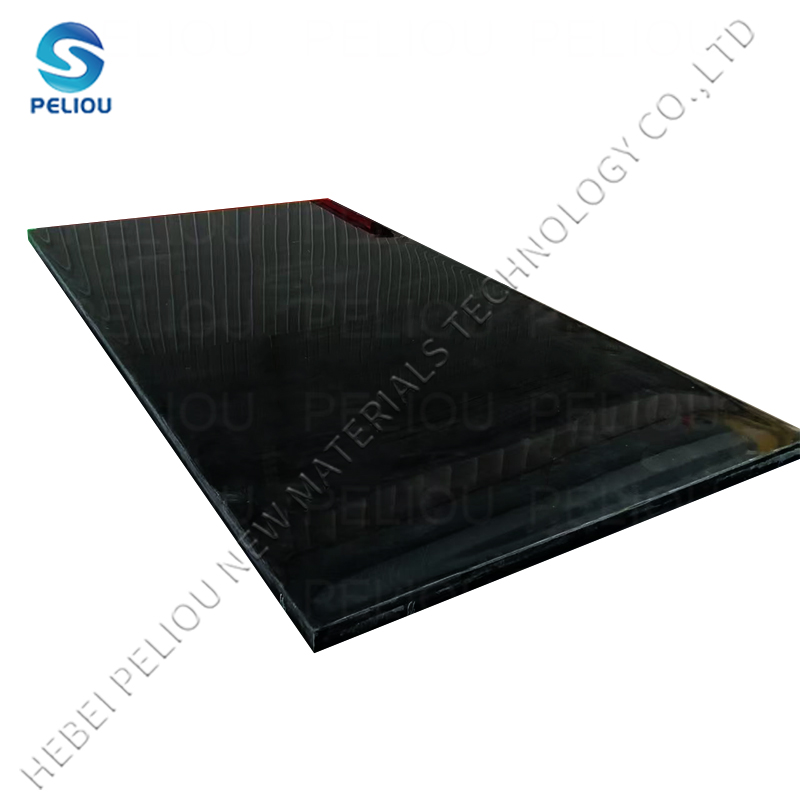
Table of Contents
- What Is Anti-Static UHMWPE Sheet?
- How Does Anti-Static UHMWPE Work?
- Key Benefits of Anti-Static UHMWPE Sheet
- Applications in Bulk Material Handling
- Anti-Static UHMWPE vs. Conventional Lining Materials
- Technical Specifications and Customization
- How to Choose the Right Anti-Static UHMWPE Sheet
- Installation and Maintenance Considerations
- Why Choose Hebei Peliou New Materials Technology?
- Frequently Asked Questions
- Contact Us for Anti-Static UHMWPE Sheets
1. What Is Anti-Static UHMWPE Sheet?
Anti-static UHMWPE sheet is a modified Ultra High Molecular Weight Polyethylene material engineered to help control the accumulation of static electricity while maintaining the mechanical advantages of standard UHMWPE.
Standard UHMWPE is well known for its excellent abrasion resistance, impact strength, chemical resistance, and low coefficient of friction. However, conventional UHMWPE is electrically insulating, which means static charges may accumulate on its surface under certain operating conditions.
Anti-static UHMWPE addresses this limitation through the incorporation of conductive or static-dissipative additives, or other specialized material formulations. These modifications provide a pathway for static charge dissipation, depending on the specific grade and manufacturing process.
- Improved static charge control compared with standard UHMWPE.
- Excellent wear and abrasion resistance.
- Low friction for smoother bulk material movement.
- Good impact resistance and mechanical durability.
- Resistance to moisture and many industrial chemicals.
- Suitable for customized industrial lining applications.
It is important to note that anti-static and conductive UHMWPE are not necessarily the same. Anti-static grades are designed to reduce static accumulation, while conductive grades are formulated to provide higher electrical conductivity. The appropriate grade should be selected according to the electrical requirements and safety conditions of the application.
2. How Does Anti-Static UHMWPE Work?
Static electricity can develop when materials move, rub against surfaces, or separate during industrial processing. In bulk handling systems, friction between plastic liners, metal structures, and moving particles may generate electrostatic charges.
If these charges cannot dissipate effectively, they may accumulate on equipment surfaces. Under certain conditions, this can contribute to electrostatic discharge, dust attraction, and operational concerns.
Anti-static UHMWPE uses specialized formulations to improve its ability to dissipate accumulated electrical charges.
Static Charge Dissipation
Conductive or static-dissipative additives can help create electrical pathways within the UHMWPE material. These pathways allow electrostatic charges to dissipate more effectively than they would on conventional insulating UHMWPE.
Reduced Material Adhesion
UHMWPE naturally has a low coefficient of friction and a non-stick surface. These properties help reduce material adhesion and buildup in chutes, hoppers, and storage equipment.
Improved Material Flow
By combining low-friction surface characteristics with static-control properties, anti-static UHMWPE liners can help improve bulk material movement and reduce certain material handling problems.
However, the actual static-control performance depends on the electrical resistivity of the selected grade, grounding arrangements, installation methods, and operating environment. It should be verified through appropriate testing.
3. Key Benefits of Anti-Static UHMWPE Sheet
3.1 Excellent Wear and Abrasion Resistance
One of the most important advantages of UHMWPE is its outstanding resistance to abrasive wear. In bulk handling applications, materials such as sand, coal, minerals, cement, and plastic granules continuously contact equipment surfaces.
Anti-static UHMWPE sheet offers a durable lining surface that can withstand repeated material movement and abrasion. This helps extend the service life of equipment and may reduce the frequency of liner replacement.
3.2 Effective Static Control
Static electricity is a particular concern in environments where dry powders, fine particles, and combustible dust are handled. Specialized anti-static UHMWPE grades can help reduce surface charge accumulation.
This makes them useful for selected industrial applications where static dissipation is an important material requirement.
For hazardous or combustible-dust environments, anti-static plastic alone does not guarantee explosion protection. A complete electrostatic risk assessment, suitable grounding, and compliance with applicable safety standards are essential.
3.3 Low Coefficient of Friction
UHMWPE has a naturally low coefficient of friction, allowing bulk materials to slide more easily along lined surfaces.
This property can help reduce material sticking, improve discharge efficiency, and minimize the accumulation of materials inside storage and transportation equipment.
3.4 High Impact Resistance
Industrial handling systems are often exposed to heavy loads, repeated impacts, and sudden material drops. UHMWPE provides excellent impact resistance, even in demanding operating environments.
Its toughness helps protect equipment surfaces from damage caused by repeated material impact.
3.5 Chemical and Moisture Resistance
UHMWPE offers good resistance to water, moisture, and many common industrial chemicals. This makes it suitable for various material handling environments where corrosion and moisture exposure are concerns.
Chemical compatibility should still be evaluated based on the specific chemical, concentration, temperature, and exposure time.
3.6 Reduced Maintenance Requirements
By reducing abrasion, material buildup, and friction-related problems, UHMWPE lining systems can help lower maintenance requirements.
A properly selected and installed anti-static UHMWPE sheet may contribute to improved equipment reliability and reduced downtime.
4. Applications in Bulk Material Handling
Anti-static UHMWPE sheets are suitable for a variety of industrial applications where wear resistance, smooth material flow, and static control are required.
4.1 Hopper and Silo Liners
Hoppers and silos are commonly used to store and discharge bulk materials such as powders, grains, pellets, and minerals.
Material sticking and buildup on internal walls can affect discharge efficiency. UHMWPE liners provide a low-friction surface that helps materials move more smoothly.
Anti-static grades can be considered when electrostatic charge control is also required.
4.2 Conveyor System Liners
Conveyor transfer points and chutes are exposed to continuous friction and material impact. Installing anti-static UHMWPE sheets in selected areas can help protect equipment surfaces from abrasion.
The low-friction properties also help reduce material accumulation along transfer surfaces.
4.3 Mining and Mineral Processing
Mining operations handle abrasive materials such as coal, ores, gravel, and mineral aggregates. These materials can cause significant wear to conventional steel surfaces.
UHMWPE lining sheets provide an alternative wear-resistant solution for selected hoppers, chutes, storage bins, and transfer systems.
4.4 Chemical and Powder Processing
Chemical processing plants and powder handling facilities often require materials with reliable chemical resistance and static-control characteristics.
Anti-static UHMWPE sheets can be considered for selected equipment surfaces, provided the material grade is compatible with the chemicals and the required electrical performance.
4.5 Plastic Pellet and Granule Handling
Plastic manufacturing facilities frequently transport and store resin pellets and plastic granules. Friction during material movement can generate electrostatic charges.
Anti-static UHMWPE components can help address static-related material handling concerns while providing a wear-resistant contact surface.
5. Anti-Static UHMWPE vs. Conventional Lining Materials
Choosing the right liner material is important for equipment performance, maintenance costs, and operational efficiency. The following table provides a general comparison of commonly used lining materials.
| Material | Wear Resistance | Friction | Static Control | Impact Resistance |
|---|---|---|---|---|
| Anti-Static UHMWPE | Excellent | Low | Grade-dependent | Excellent |
| Standard UHMWPE | Excellent | Low | Generally insulating | Excellent |
| HDPE | Moderate | Moderate to low | Generally insulating | Good |
| Steel | Grade-dependent | Higher than UHMWPE in many applications | Conductive | High |
| Rubber | Grade-dependent | Variable | Grade-dependent | Good |
The best material depends on the operating environment, abrasive characteristics, material temperature, impact loads, chemical exposure, and electrical requirements.
For applications requiring both abrasion resistance and static dissipation, anti-static UHMWPE may offer a useful combination of properties.
6. Technical Specifications and Customization
Anti-static UHMWPE sheets are available in different sizes, thicknesses, colors, and electrical performance grades depending on the manufacturer's production capabilities.
Typical product specifications that buyers should evaluate include:
| Specification | Details |
|---|---|
| Material | Anti-Static Ultra High Molecular Weight Polyethylene |
| Product Form | Sheet, Plate, Liner, Customized Components |
| Thickness | Customized according to application requirements |
| Length and Width | Standard or customized dimensions |
| Color | Depending on available formulation |
| Surface | Standard smooth or customized finish |
| Electrical Properties | Specified according to surface or volume resistivity requirements |
| Applications | Hopper Liners, Chutes, Conveyors, Storage Bins |
Actual specifications vary according to the selected formulation and production process. Buyers should request technical data sheets and test reports to confirm the material's electrical resistivity, mechanical properties, and dimensional tolerances.
Customized Anti-Static UHMWPE Sheets
Different industrial applications require different sheet dimensions and performance characteristics.
Customization options may include:
- Customized thickness, length, and width.
- Different anti-static or conductive formulations.
- Customized colors according to production availability.
- CNC machining and cutting services.
- Drilled holes and mounting configurations.
- Customized liners for industrial equipment.
Providing equipment drawings, application details, and electrical performance requirements can help manufacturers recommend a suitable material solution.
7. How to Choose the Right Anti-Static UHMWPE Sheet
Selecting the correct anti-static UHMWPE sheet involves more than choosing a thickness or color. Buyers should evaluate the operating conditions and technical requirements of the application.
7.1 Determine the Required Electrical Performance
Identify whether the application requires static-dissipative or conductive material. Ask the supplier for the electrical resistivity range and the test method used.
7.2 Consider Abrasion and Impact Conditions
Evaluate the type of bulk material, particle size, hardness, flow speed, and impact intensity. These factors influence liner thickness and expected service life.
7.3 Check Operating Temperature
UHMWPE performance can change with temperature. Confirm the operating temperature range with the supplier, especially for applications involving hot materials or outdoor temperature fluctuations.
7.4 Evaluate Chemical Compatibility
If the material is exposed to chemicals, oils, cleaning agents, or other industrial substances, verify compatibility with the specific UHMWPE formulation.
7.5 Confirm Installation Requirements
Consider mounting methods, fasteners, sheet dimensions, expansion allowances, and grounding arrangements where applicable.
For static-sensitive installations, the complete system design should be reviewed to ensure that the liner, connections, and grounding measures work together effectively.
8. Installation and Maintenance Considerations
Correct installation is essential for achieving reliable performance from anti-static UHMWPE liners.
Surface Preparation
Before installation, clean the mounting surface and remove dust, oil, rust, and loose particles. Ensure that the supporting structure is suitable for the selected liner.
Mechanical Fixing
Depending on the equipment design, anti-static UHMWPE sheets can be installed using suitable mechanical fasteners or customized mounting systems.
Thermal Expansion
UHMWPE has a relatively high coefficient of thermal expansion compared with metals. Proper expansion allowances should be considered during installation to prevent buckling or deformation.
Grounding and Electrical Continuity
When static dissipation is required, the installation must account for electrical continuity and grounding. Do not assume that simply installing an anti-static sheet automatically provides a grounded system.
Regular Inspection
Inspect the liner periodically for wear, damage, loose fasteners, and changes in electrical performance where required. Replace components when they no longer meet operational requirements.
9. Why Choose Hebei Peliou New Materials Technology?
Choosing a reliable UHMWPE sheet manufacturer is important for obtaining consistent product quality and suitable material performance.
Hebei Peliou New Materials Technology Co., Ltd. focuses on engineering plastic materials and industrial plastic solutions for different application requirements.
When sourcing anti-static UHMWPE sheets, customers can discuss their specific requirements with our team, including:
- Material selection for bulk material handling applications.
- Customized sheet dimensions and thicknesses.
- Anti-static and conductive material requirements.
- Wear-resistant plastic lining solutions.
- Technical specifications and product customization.
- Application-based product recommendations.
Whether you need anti-static UHMWPE sheets for mining equipment, industrial hoppers, conveyor systems, or powder handling facilities, selecting the correct material grade is essential for long-term performance.
10. Frequently Asked Questions
Q1: What is anti-static UHMWPE sheet used for?
Anti-static UHMWPE sheet is used in industrial applications that require wear resistance, low friction, and static charge control. Common applications include hopper liners, conveyor chutes, storage bins, mining equipment, and bulk material handling systems.
Q2: What is the difference between standard UHMWPE and anti-static UHMWPE?
Standard UHMWPE is generally electrically insulating and may accumulate static charges. Anti-static UHMWPE contains specialized formulations designed to improve static charge dissipation while maintaining many of the material's excellent wear and mechanical properties.
Q3: Is anti-static UHMWPE suitable for mining applications?
Yes. Anti-static UHMWPE can be considered for selected mining applications, including chutes, hoppers, and storage equipment. Its abrasion resistance, impact strength, and low friction make it suitable for many bulk material handling conditions.
Q4: Can anti-static UHMWPE sheets be customized?
Yes. Depending on manufacturing capabilities, anti-static UHMWPE sheets can be supplied in different thicknesses, dimensions, colors, and electrical performance grades. Customized cutting and machining may also be available.
Q5: Is anti-static UHMWPE the same as conductive UHMWPE?
No. Both materials are designed to manage electrical charge, but their electrical properties can differ significantly. Anti-static materials are intended to reduce static accumulation, while conductive materials provide a higher level of electrical conductivity. Always confirm the required resistivity range with the supplier.
Q6: How do I select the correct thickness of an anti-static UHMWPE sheet?
The required thickness depends on the type of bulk material, abrasion level, impact conditions, installation structure, and expected service life. Providing equipment drawings and operating details will help determine an appropriate thickness.
11. Contact Us for Anti-Static UHMWPE Sheets
Looking for a reliable Anti-Static UHMWPE Sheet for your bulk material handling equipment?
Hebei Peliou New Materials Technology Co., Ltd. can discuss your application requirements and help you identify a suitable UHMWPE material solution.
Contact our team for product information, customized dimensions, technical specifications, and quotation requests.
Hebei Peliou New Materials Technology Co., Ltd.
Email:info@plasticsuperior.com
Inquiry: Anti-Static UHMWPE Sheet for Bulk Handling
Send us your required dimensions, thickness, application details, and electrical performance requirements. Our team will be glad to discuss a suitable solution for your project.


